I've finally gotten round to registering for some proper web space and got a nifty free domain name with it, so, www.davidhing.com is now my very own internet realm.
I am in the process of setting up a new blog called "Chaotic Tortoise", partly because I'm fed up of telling people the name of my blog and then having to say "no, it's nothing to do with the film". Admittedly, I'll probably have different problems and furrowed brows when declaring the name "Chaotic Tortoise" but regardless, they'll be DIFFERENT problems. It keeps things fresh and interesting.
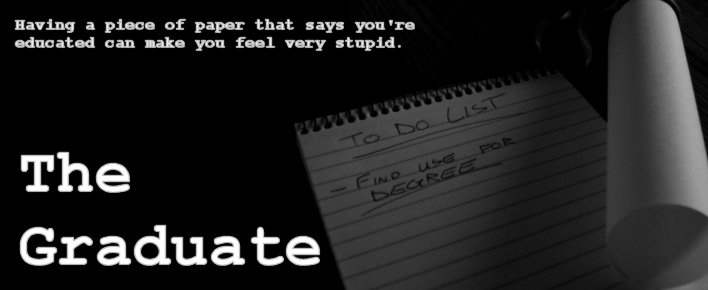
I'm also doing this partly due to the relatively tentative steps I've made to making up my mind about what I want to do with my life and so the indecisive "find use for degree", although still perfectly valid and not totally abandoned, is less of a pressing issue at the moment, thus a brief reinvention feels welcome.
Additional Notes:
I am now going to be using Wordpress for my blogging needs as it feels very customizable and should be a decent learning experience. In case anyone else is thinking of starting a blog, Blogger is a fine and reliable service and I would still highly recommend them to anybody.
Showing posts with label The Graduate. Show all posts
Showing posts with label The Graduate. Show all posts
Saturday, 26 September 2009

Wednesday, 9 September 2009
Pros and Cons of Living with Less People
Recently, our cozy little flat has undergone a reshuffle. Best friend, Best friend's girlfriend (who is also a friend) and four Chinchillas have moved out, leaving in their wake a lot of space. My girlfriend and myself have stayed behind in the belief that we can use this space. There are definite upsides and downsides to this scenario.
Pro: There is a lot more space.
Con: I miss my friends. Even though I could go for days without knowing if they were coming back or not, I knew that they were coming back at some point. Now I'm just left thinking "where the devil are they? They've been gone for ages this time!" and expecting to hear the key in the lock any moment. I'm probably never going to live with people like my departed friends again. Nobody can live with someone for any length of time in a harmonious manner, but we came pretty close for the most part, which is pretty impressive considering I've lived with my best friend for six years now.
Pro: I have a choice of three rooms to leave my stuff in.
Con: I have a choice of three rooms to try and find my stuff in.
Pro: It's quite quiet a lot of the time.
Con: It's quite quiet a lot of the time. This is excepting the as-yet unfinished unfurnished room in which just typing this is causing an echo. Equally, whereas before I could just write off funny noises as "probably chinchilla related", now I'm much more tuned in to what sounds like the undead trying to clumsily squeeze through our letterbox.
Pro: I'm on my own a lot more.
Con: ...You can probably see a pattern forming here. I'm on my own a lot more.
I know I remember my time in Manor House with fondness, but I also know that after two years we were pretty much ready to move out and another year together might have resulted in us being unable to be the relatively close friends we all are today. I also know that it's been different for the last two years living here as two couples, all four of us running on slightly differing schedules and with different priorities, but that's all it has been for me: Different. Not better, not worse, just different. I've been incredibly lucky with my friends and even luckier that I'm able to keep such people after living with them. I understand people normally move out whilst not actually talking to each other any more.
Additional Notes:
I've discovered that one of the cupboards in the hallway buzzes. There is some form of electrical thingy in there, so I've decided I'm not going to tune in to that frequency of noise anymore and just pretend I haven't noticed anything, hoping for the best in the process. I'm sure it'll be fine. It's not like a little electricity hurt anyone after all. Electricity is there to help you, not hurt you.
On a personal note, I'm delighted to see that after the one hundred and one problems that my friends have had sorting out their new place, they're finally starting to settle and showing all the hallmark signs of being incredibly happy with the place (I have seen it. It is fantastic.) and I will miss them a lot. They have been incredibly good, trustworthy, honest people and it's been a pleasure to live with them.
Monday, 24 August 2009
Notes on the CBBC Masterclass
I was reading a follow up report to some of the short listed writers for the CBBC masterclass that were selected from a competition that I entered with a script that I realised slightly too late was probably a bit too similar to "Star Wars" mixed in with slight derivative "Final Fantasy VII". The writer in question, a Michelle Lipton, writes that they were shown a clip from a show written by Russel T Davies called “Children’s Ward”.
“The clips were from a 1996 episode written by Russell T. Davies that went on to win a BAFTA Children’s Award for Best Drama. Steven said that although the episode was over a decade old, he thought it could still be broadcast today without it appearing dated.The storyline dealt with the subject of internet grooming in chatrooms – a boy was being lured to a meeting in a park (in order to buy a rare comic) by a man pretending to be another schoolboy .Steven asked us all to guess how the episode ended – and I don’t think anyone got it right. Although the boy escapes – just – so does the man, and the bleak final shot has him in the park, walking another child he has lured, back to his car. That’s a hard-hitting ending for TV drama in general, let alone a children’s drama.”
The concept of not talking down to children is one that I'm familiar with and it's true that children are capable of all manner of big ideas, dark concepts and all manner of things that would terrify any ordinary grown adult. I'm not trying to criticise the subject matter either; A child would see the above and not find it as sinister or as an adult would, as children are always told not to walk off with strangers and it's only really the adults that can formulate ideas about what happens after the kidnapping. The problem that I have with that being children’s drama is that it's...well, a bit dull.
Obviously, it can be seen as a brave thing to do, if only because although the character we care about escapes, the villain doesn't receive any sort of retribution. But the concept and the set up just seems too much like one of those videos they show you at school warning you not to play around industrial farming equipment, swim around in quarries or jump in front of tractors. Anything like this that I would have seen as a child would have caused me to switch off instantly. I'd be surprised if there is anyone that remembers "Children's Ward" as their favourite show as a child, or if they even remember it without having to think for a few minutes. No matter how well it may be written, and Russell T Davies is pretty good, the whole setup and premise of the show would just leave me stone cold and although I may not be a standard archetype for the rest of humanity, I'm sure I'm not alone in that.
Additional Notes:
I haven't read much more of Michelle Lipton's blog, but if you are also a new writer, it looks to be pretty good.
I don't know if you know what I mean by those videos that warn you about the dangers of playing in a grain hoppers, or the dangers of playing "pin the tail on the live agitated bull", and maybe I only saw these sorts of things because I grew up in a very rural area where these sorts of things could potentially happen, but some of them stuck with me, if only because of the slight absurdity. I remember one video that was called something along the lines of "EVERYBODY ON THIS FARM WILL DIE IF THEY'RE NOT CAREFUL AND THEY'RE NOT" or something equally terrifying, and the plot consisted of the eldest sister of a large family that lived on a farm being warned by a ghost that various siblings were on the brink of death as a result of games of "Hide and Seek: Idiot Edition". The ghost had clearly died from all of these methods in the past and the older sister being switched on and sensible very diligently runs around the farm rescuing her kin from their impending doom. The bizarre bit happens right at the end. The ghost has clearly taken a bit of a shine to the girl and would like some company in the afterlife, so doesn't warn her about the tractor, which unexpectedly squashes her just before the end credits. I'm not sure if this was meant to be as hilarious as we all found it or if it was meant to be more of a "and just to show you that we're serious, we're killing one of the characters" moment. Also, at least one person came away from the screening thinking "hey, playing on farms looks fun! I never thought of that!".
(If anyone has any idea what I'm talking about, please let me know what the video was actually called because it's driving me mad.)
Thursday, 20 August 2009
Robin Hood but Not Robin Hood
A few years ago, I decided that I wanted to have a go at writing a version of Robin Hood for television. The angle I was going to take with it was that Robin Hood was not a noble folk hero acting as the original working-class-hero, but that he was just a very consistant thief who stole everything that wasn't nailed down. The story was going to start with him being blackmailed into acting as the noble character that has survived through legend by a rather manipulative Friar Tuck who saw Robin as a way to lift the spirits of the downtrodden masses. There were other elements such as the fact that Robin owed Little John, the local loan shark and general medieval-mobster, an inordinate amount of money, the Sheriff was just a local nobleman trying to do his job and make all the numbers add up, and in general there were a few half decent ideas floating around there that could have produced something that wasn't too bad.
Then the BBC made a version of Robin Hood. I'm not a fan.
I thought that it looked pretty good at first. Promotional posters looked like it was taking a slightly more interesting approach to the character than normal, and I was optimistic about this. Ok, so I probably had to shelve my little project for a while, but perhaps the show would have been ok and much better than I could have done.
I think I survived the whole of the first episode, but I didn't come back to it again. I'm not even too sure what it was about it that repulsed me so much. Maybe it was the plastic-looking axes, the annoying text affects when the scene changed, maybe it was retooling Maid Marrion to be a cross between Lara Croft and Batman (or maybe I'm remembering that wrong) or maybe it was just that there was something everso slightly off about the whole thing. As a quick disclaimer, I acknowledge that there is every possibility that the show found its feet and that the first episode was a glitch and that it's grown into a fully fledged multiple award winning juggernaught of a show, although I doubt it.
I'm not really saying that I could have done better. I don't know whether I could or not. I haven't done anything like that yet all the way through so I can't criticise just yet, but I was annoyed that my ideas were now somewhat invalid by what I can't help feeling is a missed oppurtunity.
A brain wave recently hit me that I could keep my project after all, if I just twisted it slightly, resulting in starting work on a script that is at present titled "Guild of Thieves". I'm using the same scenario, but changing the setting to be set in a city as opposed to Sherwood forest, altering the characters slightly and putting new ones in and essentially changing all but the bare premise. It's turning into a much more interesting beast that I'm ten times more excited about each time I sit down to write something for it, and it also makes me look a little bit more creative than I actually am. Depending on how much further I get with it, I might share some less vague details about it, but for now, think Robin Hood, but Not Robin Hood.
Additional Notes:
Apparently, BBC Robin Hood has been filmed in Hungary. Although that's possibly why it just didn't feel quite right, I do however find it unlikely that my subconscious would have been that eagle eyed to spot subtle differences between the English and Hunarian countryside.
I'm also told that there'll be a new Robin Hood film coming out soon starring, wait for it, Russel Crowe, as Robin Hood. Now, I don't mind Mr. Crowe. I think he's pretty good at what he does and I don't think Gladiator would have been quite as iconic without him, but I just can't quite see him as the prince of thieves...maybe I'm just missing the point and have got too used to my idea of scrawny, scruffy and morally questionable Hood.
Tuesday, 18 August 2009
Creative Crunch
An oft mused upon subject of mine that occasionally leaks its way out of my brain is that sort of meta-creation whereby something comes into being as a result of being bored, or not knowing what to do. This blog entry is an example of such a creature. What happens is thus: A writer, artist or otherwise creative type gets their own particular brand of writers block and is unable to think of what to do. As a result, they write something, or create something, based on not knowing what to do. There are quite a few things that pop into existence this way. On one end of the spectrum, there are uninspired blog posts that whine about not knowing what to do, and on the other end you get TV shows like Spaced, which appears to be solely about being stuck in some sort of creative vacuum without knowing what to do.
I’m not really making a point here about anything in particular, I’m just commenting on my own complete lack of enthusiasm. It’s been particularly bad lately, but there are two things that I feel could possibly pull me out of this. The first is fantastic advice as seen on 43 folders amongst other places to essentially get on with it and stop complaining, and the other is some sort of structure. It has been established by some friends of mine that Tuesdays are now a day for making things and being creative, a sentiment that I hope to uphold religiously, possibly obsessively if things go well.
My current personal project to take me out of the creative crunch is to complete a script for a semi-adaptation of Robin Hood, but that isn’t Robin Hood, because the BBC already did that. Sort of. Depending on how that goes, I might update on my progress.Additional Notes:
My particular brand of writers block has nothing to do with inspiration, but more to do with a lack of effort required to actually make me do something with the inspiration, normally resulting in me firing up (or shooting up...I’m never sure which is the appropriate way of saying it) Warcraft instead and vaporising the evening in one fell swoop.
In personal news: I’ve finished my law course completely. My final essay was handed in with much drama and confusion when there was no plausible way of submitting it, but I just interpreted that as some kind of final test. I didn’t fall through the trap door into the maw of the leopard, therefore I think I passed.
Tuesday, 21 July 2009
New Projects and Hard Work in Animation
I’ve always had a profound love of cartoons. I feel like I’ve probably said all this before, but I distinctly remember that as a child I would much prefer anything animated over anything with real life actors in, because anything with real life actors in was either gritty and boring or wacky and annoying. Sometimes it was a mixture of all four, which as you can imagine is difficult to pull off.
I find that once I’ve latched onto something, I want to make my own of that thing. It has happened with comics, with music, with computer games, with fiction, with television, with miniatures and with anything I’ve had small obsessions with in the past. Due to the sporadic nature of my attention span, I therefore have dozens of half finished comics, some half baked and shakily recorded songs, a load of lazy coding that bears some small semblance to a handful of computer games, a small hard-drive’s worth of unfinished and partially started novels, several scripts for TV dramas and sitcoms, and even a few small humanoid-like shaped twists of wire encased in modeling putty.
Of course, I’ve tried to do little bits of animation in the past. I have a small selection of experiments that I threw together in Adobe Flash that don’t really do much. There’s quite a nice one of a penguin singing a little bit and walking off, but it’s very primitive. I recently came to the conclusion through no discernable mode of decision that it was time to give animation another try. I had been recommended a book written by Richard Williams, the creator of “Who Framed Roger Rabbit?” so I found a copy of that and started to leaf through it.
There were probably two things in that book that made me get to the picking-up-the-pen-and-paper stage of the project and away from the much more alluring but-I-need-to-read-more-tips stage. The first one was that Richard Williams, who in my mind is an absolute master of his field, started animation in earnest at the age of 22. Psychologically, this is a massive boost. I am under the increasing impression that if you want to be good at anything, you have to have been doing it since the age of 8 and never attempted or wanted to do anything else, which if you look at the half finished novels, scripts, miniatures, games, symphonies and coffee tables littering my life you can imagine is a fairly discouraging thought.
The second revelation was one of those statements that everyone knows but sometimes people just need to be told again. The gist of it was that animation takes a lot of work. A lot of work. More than a lot of work.
Everyone knows that animation takes a lot of time and effort. We’ve all heard the stories of how the makers of Wallace and Gromit took six months to make half a second of film (that might be a slight exaggeration) but I think a large part of me assumed that there was a quicker way of doing it that would get results that were just as good through using a computer. Just knowing that if I wanted to attempt anything in animation it would take a long time and a lot of work was enough to make me start working on it. Being able to come to terms with the fact that it wasn’t quick and easy was enough to make me stop trying to find a quicker and easier route.
Once you know that what you’re experiencing is normal, or once you’ve been told to expect a high volume of work or trouble, it makes that hurdle easier to deal with psychologically. Once you know your first script is going to be rejected by the BBC, it means that when it is, it isn’t a problem and you can get on with the next one. Once you know you’re not going to get the first job you apply for, it makes it easier to search for the next one. Once you know you probably won’t even get a rejection letter from the first job you apply for, it makes it easier to apply for the next one. Once you know that your first miniature you carve is going to look like a dog crossed with a wildebeest when you were trying to carve an elf, it makes the next one easier to start.
Nothing in this life comes easily, and if it does come easily, it probably isn’t worth it. This is all old stuff that everyone knows, but sometimes you just need to be reminded in order to get on with it.
Additional Notes:
Calling my songs half baked is an accidental pun: One of my better songs is called Undercooked.
I’ll confess my animation hasn’t gotten too far, but I’ve made headway onto a walking pattern and apparently getting a character to walk across the screen convincingly is one of the hardest things to do.
The book that I’ve bought and that I would highly recommend to anyone that wants to try animation is the Animators Survival Kit by Richard Williams. “Who Framed Roger Rabbit?” is still an excellent film and if anyone reading this has not seen it, try to. It’s still funny and it’s still clever.
Monday, 6 July 2009
A little bit Extra
Last week, I spent two days in a night club getting incredibly hot and sweaty, slightly bored and having to dance every now and then against my wishes. However, whereas I normally have to pay an entrance fee for this sort of experience, this time they were paying me, because I was one of about two hundred background artists being filmed as part of Ricky Gervais’ latest venture into the world of film.
Working as an extra is a lot of fun and I’d recommend it to anyone, regardless of whether you’re interested in the industry or not, because it just gives you such an appreciation of just how much work goes into these productions. The two days that lasted approximately twelve hours each probably constituted at most around five minutes of the film. The longest scene included one and a half pages of dialogue, which should equate to one and a half minutes. The number of times the retake scenes to get the best one possible is staggering, when they filmed the short fight scene that took place it took an entire afternoon so that they could film it from several different angles and mash it together afterwards and it was just unbelievable just how much time and effort the crew were dedicating to the project. What I can’t get over is that after those two days I was on the set, the rest of them carried on going with similar schedules the next day, albeit without two hundred extras, most of which behave like slightly arrogant sheep that are desperate to one day become a shepherd, or at least a supporting sheep dog.
This leads me to talk about some of my co-extras. That last statement I’ve just made probably makes it sound like high levels of contempt are being held on my behalf, but this isn’t the case. I honestly felt like most of us, myself included, at points in the day were like arrogant sheep. They still follow where they’re directed, but they complain about it a little bit and are under the delusion that their actions will lead to bigger and better things. Everyone I spoke to was very friendly and all of them interesting people. I got a few laughs when I said what I did for a living and did suddenly feel it a little absurd that I’d chosen to take two days holiday to go and stand in Koko at five in the morning until five in the afternoon when I was talking about how I wasn’t really intending to try and become a professional actor and it was very clear that I had one of the most stable day jobs there and almost everyone else worked in the industry or were at least desperately trying to.
But in fairness, at the age of twenty-four, I was one of the older extras there. Almost everyone else had just finished university, some had just finished college and were thinking about going to university, and a lot of them were saying something along the lines of “I’m going to move down to London soon and find work down here as an actor/actress” as if they hand work out at the job centre. I think what hit me about these statements is that shortly after university, that was probably my plan as well, however unreasonable it might have been. I’m not sure if it was a roomful of naivety, potential, or just sheer hope, but it was something that I felt surprisingly alien. I want to share that hope again, that idea that everything will work out by just being in the right place at the right time, and I honestly hope that some of these wild theories pan out for at least some of my co-extras. They were nice people and deserve a decent break.
All in all, it was a fun couple of days out that wore me out something stupid, but was completely worth it. I’d recommend it to anybody else, if only to experience that odd mixture of being incredibly excited and bored out of your mind at exactly the same time.
Additional Notes:
The film in question is called “Cemetery Junction” and should be out in 2010. I am wearing tight brown flares and a slightly-too-tight green tee-shirt and dancing horribly, so maybe you’ll be able to spot me quite easily.
Stranger things have happened: Apparently Harrison Ford was a carpenter on the set of Star Wars when he was pulled in to play Han Solo. I mentioned this to one of the extras I was talking to by way of conversation that had steered itself in that sort of direction. I don’t think he was really listening because he immediately dismissed this as “not a terribly effective career move”, as if I had been deadly serious in suggesting that the way to become a supremely successful performer was to train in carpentry.
Thursday, 25 June 2009
Film: Terminator Vs Transformers Vs Star Trek
I have now seen all of this unholy trilogy that is being constantly referred to as “the summer movies”, a phrase that makes me wince ever so slightly, as if the only reason I’ve seen these films is because they have been carefully and perfectly marketed to me in order to catch some kind of summer vibe that requires, nay, demands to see things fight each other, win romantic conquests, blow up or a combination of all three.
From this squabble of “summer movies”, I’m going to ascertain a clear winner and a runner up. Let me first of all establish that surprisingly, none of them were out and out bad. If you have to pick one and you find yourself not wanting to read through the rest of this, see Star Trek, but I think I’ve already said that in a previous post.
Terminator: Salvation
I hear lots of people calling this Terminator 4, which it is, essentially, but I’ve noticed a trend with these films in that they’ve abandoned numerical identification, almost as if they are trying to trick us into thinking these are new, original, not-in-any-way-a-sequel ideas. The fourth film in any series definitely seems to be the final nail in a franchise shaped coffin, with exceptions of very long running series’ such as the James Bond films. There may be a reason for this in that we are used to the format of a trilogy and the well trodden beginning middle and end. You look at any trilogy (preferably one that was planned to be as such) and you should see the beginning in the first film, the ending in the third film, and the second film containing almost pure plot and struggle (or struggling plot in some cases). Even trilogies that only become trilogies after the success of the first film such as the original Star Wars, the Matrix or Pirates of the Caribbean seem to follow this structure, so it’s clear we’re happy with three films in a series before we start to lose interest. A fourth film will always destabilize how an audience will feel about the other products. The Alien series is probably a good example of this in that the fourth film can only really be described as “snooker loopy” with the main character being a resurrection of the main character from the previous films through the method of replicating her DNA through the ashes that remained of her body after the third film. Although the fourth film wasn’t all bad (the script was pretty good and the characters for the most part solid) it served to remind me that the whole franchise had started to go rapidly down hill. Terminator Salvation did the same thing. Instead of enjoying the film, I couldn’t help thinking about how much better earlier incarnations were. Terminator was fun, Terminator 2 was remarkable and probably the only film that I can see as better than the original, and Terminator 3 threw everything out the window and started heading rapidly down hill again, exactly as it did with the Alien films.
Focusing more on the film as opposed to half-baked theory on audience tolerance and running the same idea through the sequel grinder, I can’t put my finger on exactly what was wrong with Terminator Salvation. It had some promising moments, it had some decent if underdeveloped characters and it was great to finally see a bit more of the post-apocalyptic world that was teased at the beginning of Terminator 2. Unfortunately, the post-apocalyptic world that was teased at the beginning of Terminator 2 was much more bleak and dramatic in my imagination (and I know it’s difficult to make some both bleak and dramatic at the same time so I really do expect too much from my films), they had John Connor as the main character instead of the far more interesting half-man half-machine character that was introduced, and the promising moments were near the beginning of the film that were quickly abandoned around about the time a giant humanoid transformer style robot with bikes that launched from his thighs turned up, delicately picked up some humans and put them in his basket, blew everything else up and rode off on the back of a flying machine.
I feel like I’m being harsh on this film when I think back on it. It was better than the third film, but the third film still felt more like a Terminator film. I suppose now I’m being incredibly difficult to please by seeming to demand original material yet original material that adheres close enough to what has come before it.
Transformers: Revenge of the Fallen
This one was pure unmitigated fun. Following my logic discussed previously, this being the second film in the series, if it were a trilogy, we’d be into the substantial meat of the story. As it happened, Revenge of the Fallen is allegedly the final Transformers film that Michael Bay intends to direct, so actually what we got was substantial story and an ending, but that is said with a caveat the size of China in that putting the words “substantial”, “story” and “Transformers” together isn’t truly representative of what I’m talking about. I’ve read reviews about this film that say it’s boring, along the lines that fireworks are boring: See one firework and it’s impressive, spend an evening watching fireworks and it becomes dull, only replacing the word “firework” with the phrase “robot turning into a car/plane/tiger”. I can’t honestly say it was boring. Apparently the film was very long, but again, I can’t really say I noticed. Some people have said the plot is confusing, or not there, or somehow hidden. This again is probably not fair; I think if you think about it for too long it will disappear, but there is a plot in there somewhere and it holds up well enough to have transforming robots beating up transforming robots, and really, if you’re expecting Citizen Kane from Transformers, someone needs to remind you that this is a film based on a cartoon based on a line of toys that became popular after Hasbro recognized that children generally want a tiny amount of back story to what they’re playing with.
Another Transformers film would wound this particular reinvention (and Transformers have been reinvented many many times before so I can’t say the franchise as a whole) and a fourth film would kill it.
This film was however, as I’ve said, fun. Really good fun. I don’t know if it was because it’s genuinely decent, or whether it was because I saw it with three other twenty-something-probably-too-old-for-this-film types, but either way, it was fun.
Star Trek
Star Trek has now had so many films, TV series’, spin offs and what-have-you that they’re pretty much coming full circle. I can’t even think of what number you could accurately pin on this film. Possibly 0 because of the fact it’s pretty much a prequel, but potentially 11, 12, 35, or whatever number they’ve gotten up to previously.
This is a franchise that is a very very brave project for anyone, even someone with decent credentials such as JJ Abrams. The use of the word “rabid” in describing even mild fans of the series is probably a massive understatement, but in short, there is a lot of room here to anger a lot of people, and from what I can see, he neatly avoids any issue like this by saying “Right. All that happened. Now this is happening as well, but earlier and differently.” To briefly explain that nonsensical statement, this isn’t a reboot or a re-imagining or a lowly remake, this is just a new series set in an alternate universe, a concept that is explored probably every five episodes of any Star Trek television series, thus making it sit perfectly well with true Star-Trek-for-life fans, and giving it room to be fun and entertaining for the newcomers to the series.
I have nothing much more to say about Star Trek other than it was very well executed, the casting was spot on, it trod the line between not-taking-itself-seriously and decent science fiction extremely well and I would recommend it to anybody, regardless of whether they like space ships or not.
The Winner Is:
I’ve already said which is the better film. In fairness to the other two however, Star Trek had its script finished just prior to the writers strike. Transformers and Terminator weren’t so lucky, and it was noticeable that for some sections, dialogue and direction was somewhat improvised. There were in fact whole sequences in Transformers that were really just showing what was going on as opposed to spending any time going through it, but I actually thought this worked quite well. A film that claims heritage to a line of toys can get away with this. A film that is known for its philosophical ramblings on the nature of man, war and inevitable self destruction can not.
If you have to pick one film to see, see Star Trek, if you can make it to two, go for Transformers, and if you can go and see three, see Wolverine, but if you’re bored, Terminator isn’t as bad as it could have been and it isn’t a complete waste of your time, just a partial waste.
Additional Notes:
Actually, I can’t even say the word movie without feeling physically ill. I don’t know what it is about the word; I just always see them as films.
I can’t remember whether I’ve mentioned Wolverine before or not. I enjoyed it, but I’m not sure why.
I suspect the real test of whether I’m right or not about Star Trek being for everyone is if my girlfriend would like it, but I’m just not brave enough to throw my theories into the field just yet. My self esteem could not take the hit if my suppositions turned out flawed.
Incidentally, at some point in the future, maybe we’ll see the actual film of Terminator Vs Transformers Vs Star Trek. I’m not saying it would be good, but it would at least be well attended.
Tuesday, 23 June 2009
Script Writing
I like to think of myself as a bit of a riter.
I mean that. I know I’m not of a professional standard, I have no real credits to my name and my only real completed projects are half baked essays and a series of underdeveloped comics. I am a riter. Almost a writer, but not quite enough credentials to really qualify.
It is with this in mind that I consider the following might be a pointless thing to say given my lack of experience or even significant effort in the field, but I find writing scripts incredibly difficult. I’m fine in the imagination department and getting ideas for a story and how it will pan out, I’m not bad and improving in the field of characterization, and dialogue, one of the most important things of a script, isn’t a major issue. What I have a problem with is putting it all together.
From a decent amount of experience making comics, I have a rough idea what does and doesn’t work in a narrative sense, largely by doing all the things that don’t work, but I never leant how to write scripts. I always had a plan, but that plan was “I’m starting here, I need to get to here” which in one case took me a whole sixteen page issue longer than I expected. With my current TV script writing project that I’ve set myself, I don’t have the option of crafting it as I go along in the same way that I did with the comics, so I have to start with the script and work it through from there.
It seems that the second you try and mash together the setting, the plot, the characters, the dialogue and the action, things go disastrously wrong. Maybe I’m getting too hung up on formatting the scrip so that it looks professional, but no matter how I write the opening scenes, it comes across as stilted, halting, and generally awful with a real struggle to get the middle ground between fast paced staccato dialogue and longer plodding exposition based dialogue.
What I’m trying to write is the first thirty minute episode for an animated children’s show. I don’t think I have an issue with writing for children, as most of the things I’ve done previously have been of the right sort of tone for children, especially so with only a little bit of tweaking, but I do have a problem with working out how to fit it all together without it becoming utterly all over the place.
Like most things I try and do, I suspect the problem I’m running in to is trying to do it all at once and assume I need to fire out my entire brain into the script in the first few pages, where actually I need to gradually leak it out over thirty, probably leaving plenty more to be deposited over subsequent potential episodes. I also reckon that this instinct of mine to try and do a whole project in five minutes isn’t helped by the fact that the people I’m submitting this to suggest making sure the first ten pages are really tight and gripping because that’s all they’re obliged to read and they’ll only read further if it’s any good, so if I have all the fun stuff happening after the ten page mark, that’s essentially the end of the project.
If anyone has any short sharp hints and tips that I could read and then ignore anyway because I’m not bad at taking advice, just bad at implementing it, I’d be very grateful to hear. Failing that, I’ll try and post some form of update if this goes anywhere.
Additional Notes:
Making mistakes is a fantastic way of learning that I fully advocate and I believe I’ve made a vast majority of them with my comic-projects. If you have the right mindset as well, looking back on those mistakes with a renewed sense of wisdom can be highly entertaining rather than utterly and crushingly depressing.
It’s also quite a kick to see how much you’ve improved from previous attempts. If you take a look at any webcomic and compare the first and most recent entries, chances are you’ll notice a marked improvement. It is incredibly satisfying to see the same thing happen to your own work. I feel really sorry for people who produce vastly inferior creations after they’ve been working in their field for a significant period of time, but that’s enough of that, I promised myself I’d stop complaining about Star Wars and grow up a little bit.
Monday, 22 June 2009
Multiple Choice
I finally retook an exam that I had failed over the weekend. I feel better now, but equally terrified.
Just to provide a quick background, my GDL law course that I recently finished off comprised of 7 major exams for 7 main topics, 1 research assignment that had to manifest in a 5,000 word essay, 1 case analysis test where we were given a fictitious chain of events to disassemble, and 1 statute analysis test. The statute analysis test involved being given a real statute to read through and then being asked questions relating to it and the methodology required to analyse a statute in general. The test was online, two hours long, and multiple choice. It was considered one of the easiest assignments and just about everyone got over 70% in their results…..except for yours truly who got an absolutely pitiful 35%.
At first I might have been indignant that the computer could have made such a ridiculous mistake, but on further contemplation, I realise that multiple choice just isn’t my thing. The substantive exams weren’t a problem. More stressful as anything I’ve done before, but unambiguous and straight forward armed with the right knowledge. The multiple choice exam was question after question with four answers that all essentially said the same thing.
I found myself analysing the questions and answers more than the statute. I was also unsatisfied by the wording of some of the answers and found them to be more ambiguous than the wording of the statute itself and some questions where I could actually think up a more appropriate answer myself than the four listed. As a result, I’m not sure if I’ve struck idiot-gold once again and blundered into a second failure. If this happens, I’m honestly not too sure what will happen to me or my overall status on completing the course. I guess I’d fail, which would be a crushing shame, not to mention wholly embarrassing for myself.
The worst part about taking and failing multiple choice exams is of course knowing that you’ve been asked a question for which the answer is actually in front of you, and you still can’t get it right.
Regardless of all of this however, I have now completely finished everything I have to do and can now concentrate on more enjoyable personal goals, such as any writing projects that I’ve been putting off.
Additional Notes:
I was going to give examples of how the test seemed to contradict itself, but seeing as the deadline is technically Thursday and there might be people yet to take it, despite the fact I have probably two readers, neither of which are doing this exam, it might mean I could be liable for cheating by discussing the exam content publicly. That would be an even more stupid way of failing my course: Complaining about failing my course due to an easy exam that I’m worried of failing.
As it happened, I very nearly sat down and wrote a whole host of things yesterday, but decided to have lunch instead and then pretty much forgot about the whole thing.
Friday, 19 June 2009
Three Strikes and you're out
In recent news, we have been hit by a few strikes of late, namely from the RMT tube strike (that admittedly doesn’t exactly affect the whole country, but living in London makes it easy to forget that the tube network isn’t everywhere) and the postal strike that seems to have jumped out on us today. Working for an insurance company that maintains a trade union client base, you would hope that I might have some sort of insider knowledge into the workings of a strike and the dynamics of a trade union, but unfortunately, I am woefully ignorant and probably about to make myself small-scale flame-bait with ill informed opinions.
What I want to know is what is the point of striking and does it actually achieve anything?
The concept of a strike is simple. A work force is disgruntled with the way it is treated, therefore it refuses to do anything until an agreement is reached. This is a good example of a simple democratic “we are not slaves and you can not treat us as such” process and is a very effective way of avoiding being maltreated as an employee. Trade unions make this whole process slightly easier, more secure and less of a risk for the workers and despite them not having nearly as much power as they did in the pre-mining Thatcher strike breaking days, they’re still a force to be reckoned with and some of the unions have a reputation for being particularly militant.
Putting strike action into context at the moment means putting it alongside the ever present news of the ever present doom-and-gloom fuelled recession and enormous record breaking job losses. All in all, an unusual background with which to be dissatisfied with having a job.
Allow me to put forward a few examples:
The RMT Tube Strike
The name “Bob Crow” has become a curse word around London, and I suspect beyond. I don’t really know what his job is like, I don’t know how well he performs his abilities, but he certainly seems to enjoy a good strike. The last strike I remember happening was over a pay rise demand that was actually granted to them before the strike was about to commence, and they went ahead with it anyway. This breaks the fundamental concept of the strike in the first place if you’re going to strike even after you get what you want. It’s almost like the confused teenager that doesn’t know how to stop sulking even after he gets his own way.
The most recent strike was almost as bizarre, almost as if the demands had been written by two people with differing agendas. On the one hand they wanted an increased focus on health and safety, yet on the other they wanted two drivers that were fired for breach of safety regulations to be reinstated. Much as it must have been fun to see the reaction of commuters when the doors on the wrong side of the train opened, it’s not exactly going to win you employee of the month.
A lot of people will complain that tube drivers are overpaid anyway. I wouldn’t entirely agree with this. They have horrible hours, they have horrible working conditions, there’s a certain amount of danger attached to the job through accident, slow deterioration of health or attack from giant moles, and in the middle of all of that is what I can only imagine is mind numbing boredom. At the same time, demanding more pay at the moment when people are being sacked left right and centre is most definitely not going to win the hearts and minds of your passengers, many of whom will earn less than half of the drivers themselves if they are even employed in the first place.
In fairness to the drivers, I did get the impression that many of them weren’t interested in striking, as many of them turned up to work after a while anyway. This could be an example of a union trying to justify its position without really caring about what its members really want, but I don’t know.
The Postal Strike
I do feel that postal strikes have somewhat lost their impact. Aside from businesses not getting a collection or a daily drop off, I’m not sure anybody notices when Royal Mail strike. Also, any impact it has on business that it might have is instantly mitigated by the fact that everyone knows about the strike and everyone knows things might take an extra couple of days and nobody really cares.
I actually find myself sympathizing for the workers on this one. Whenever they go on strike, the create a massive backlog of work for themselves, meaning they have to work twice as hard the following day. I remember our old postman coming into the office the day after a strike muttering to himself about how it was a stupid idea to strike and he didn’t want to and how he then had to work overtime.
In my woeful ignorance I’m not actually too sure why the post office are striking this time around. At a guess I would assume it’s the threat of massive job losses and huge reform or even the threat of re-nationalization, and in fairness if I was about to be nationalized into the public sector at the moment I’d strike as well, but I would be curious to know how not turning up to work really affects the potential job losses factor. I suppose the people that work extra hard the following day get a gold star or something.
The Writers Strike
This is a bit of an unusual one. I realise this happened quite a long time ago as well, but the reason I bring it up is because it’s had one of the most insidious slow-releasing affects of a strike I’ve ever seen. Rail strike: No trains for the day. Postal strike: No post for a couple of days. Writers Strike: all current seasons of TV shows come up twelve episodes short and the films being released in two years time will be awful. The reason I’ve noticed this is because I’ve recently seen two films of vastly contrasting quality; Star Trek which was written just before the strike, and Terminator Salvation, that was due to be written just after the strike started.
As far as an impact goes, a lot of people noticed that their favourite shows had suddenly finished off earlier than expected, or that their favourite oh-so-witty talk show host suddenly wasn’t so witty, and now we’re getting an echo of that impact in the cinema over this summer and probably through to Christmas. As for how effective this was at achieving their aims, I’m not sure. I know that pre-strike, writers were being denied vast sums of royalty money from DVD sales and the like, but I also know that you don’t become a writer in order to make your millions.
A final note
I don’t disagree with striking, nor do I disagree with standing up for yourself if you’re being abused in some way, but I’m just not sure that it works. Going back to themes that I’ve found earlier in this blog, it’s probably the case that I can’t see the bigger picture, and that even a small victory as a result of a strike can result in a large impact on a work force, but sometimes demands are just unrealistic. A threat of a strike also doesn’t appear to be much of a threat most of the time, more a passive inconvenience.
Additional Notes
I might write about these films later if I can muster the apathetic bile I felt for Terminator. In short, if you want to see both, but can only afford to see one through limitations of funds or time, see Star Trek, even if you hate Star Trek.
Wednesday, 17 June 2009
But how does it make money?
I’ve recently obtained some work as an extra. I’ve done some work as an extra before, and if you have made an extensive study of the film “Starter for 10”, you will have seen me a grand total of 3 times, but then, actually, if you have seen me and made a note of the superb performance that I gave, then I’ve been a lousy extra as they’re meant to melt into the background...
The thing I’ve noticed is how much time, effort, and money is being piled into this film even at such an early stage on a relatively inconsequential group of extras. I’ve already attended a fitting that was being run by several costume workers, the pay for the two days filming and the fitting itself is pretty good, and they include travel money as well. It’s also clear that there are a lot of extras that they need to work with.
My question therefore is how on earth do these damned things make money? If vast quantities of time and money are being spent on extras that are in essence untrained instructable monkeys like myself, what are they paying the camera crews, the sound departments, the writers, costume and makeup departments or the name actors, not to mention any post production that's done?
I realise that films can get fairly decent budgets and grants and can pull in a lot of money from the box office, but the scale of these productions seems gigantic, even on smaller low-budget films. I was staggered by the size of operation that was responsible for the 15 seconds of film that my 12 hour day on the set of “Starter for 10” turned into.
Finally, if you can make a decent argument for “films do make money actually”, then transfer the question to television. Clearly we’re on a smaller scale again, but I see the methods of making money through television even more intangible. Really, where does it come from? I can only assume the license fee comes to an enormous sum and revenue from advertising produces the equivalent for non-BBC counterparts.
Maybe I can’t think big. Maybe I can’t see the larger picture when it comes to film and television and revenue therein. Maybe I’m alone in thinking that somewhere, someone forgot to carry the 1 and is now sat billions of pounds in debt but doesn’t want to tell anyone because everyone enjoys film and television too much. Whatever the case actually is, from the minimal amount of time I’ve spent “working” on film sets, I’ve gained a huge appreciation for the amount of effort that goes into even the crappiest of productions.
Additional Notes:
Of course, having seen how much time effort and money goes into these things, it’s even harder to reconcile it with examples of where they just don’t get things right. Not enough films start with a script…
As a quick reccomendation, Starter for 10 is actually a very enjoyable film. A bit quirky, but great fun, and yes of course I'm biassed.
Tuesday, 2 June 2009
Back to Normal
After a brief stint of student-ship, I am now back to the treadmill of life and the setting is probably just one notch faster than is strictly comfortable at the moment, but that might just be because I’m not making the effort to keep up.
The things I have done
Over the last couple of months that things have been a little quiet here, I have knuckled down to revise for my law exams and taken them to varying degrees of success, leaving 99% of my course complete, putting me in the position of a fresh law graduate, with the crucial difference of actually having a day job.
I have also experimented in not drinking alcohol; an experiment that reached a natural conclusion of “yes, this isn’t a bad idea” before normal service swiftly resumed and I was reminded about what hangovers are like. Further tests have proved that no, the Erdinger I had a couple of months ago was not in fact off, that’s just what it does to you.
Also, in amongst my academic activities, I have started a couple of writing projects that may reach completion and that I hope to push out to a few places to see if my writingness is of a capable quality and goodness.
The things I have learnt
First of all, it is possible to enjoy something you have resented for a good six months. Towards the latter days of my law studies, I found myself utterly detesting all aspects of the subjects I had to study. Criminal Law is rather depressing, Equity and Trusts occasionally confusing, and Land Law…well, you try and read through your lease or mortgage agreement carefully, making notes of all the little clauses and provisions, and you can get a glimpse of what Land Law is like. However, towards the end during my revision, I found myself enthralled by the intricacies (with the possible exception of Land law) and found myself debating the merits of the criminal justice system with strangers on the tube.
I have also learnt that just because you like something, it doesn’t mean it can’t stress you out to an inordinate degree. I suppose anyone that’s been in a long term relationship could tell you the same thing. The exams that I took, in particular the first one, were the most terrifying I have ever had. I genuinely wasn’t sure if I could make it through them, because in my mind, I just hadn’t put the work in during the year. Normally I get by on minimal revision because I’ve paid attention and remembered stuff throughout the year, but this time I found myself doing it the other way round, or what most people would describe as “the normal way”.
Another thing I have picked up on is my ability to be more content when I think I’m working towards something. At some point, it became relatively clear to me that I wasn’t going to end up training as a lawyer fully and that I would find a different direction in life, but the mere act of going to my tutorials and lectures every week let my brain assume that I was doing something that would take me somewhere and that it didn’t have to worry about that anymore. In truth, I think this is probably what most people do; they don’t know where they’re going or what they’re going to do when they get there, but there brain assumes they must have got it figured out, because if they haven’t, then why the hell are they doing that-particular-thing-that-would-naturally-lead-to-that?
The direction to take from here
For the moment I am staying where I am and doing what I have been doing. How wise this is, I don’t know. How plausible anything else is, I also don’t know. I have however heard that now is a good time to go into politics, so who knows? The next time I wake up with a hangover, perhaps it will be off to the local recruiting station and signing up to the front line of whichever political argument is the flavour of the month.
Additional Notes
Saying something like “I suppose anyone that’s been in a long term relationship could tell you the same thing” is a really good way for me to find out if my girlfriend does actually read this…
I’ve actually missed writing in this. I probably need to work on my blog-ability though. Having read a few blogs of late, I can see that slightly shorter posts are probably the way to go. My long pointless rambling style means very few people make it down this far.
If you made it this far by the way, thanks and congratulations! You win!
Wednesday, 1 April 2009
3 Tips to Help with Revision
As I rapidly approach my final exams for my law course, I realise that it was naïve to the think my days of preparing for exams were at an end in my final year of university. Even if in the future, I never take another exam in my life, I’m sure I will still face some form of revision in my professional capacity, whatever that may entail. Everyone needs to revise things every now and then; they just probably don’t acknowledge that they are doing it. Below are three quick tips that you probably already know.
Re-Vision: Seeing again
This first piece of advice is probably not terribly helpful to most people, but it really helps if you’ve looked at everything that you are trying to revise already during the year. Revision essentially means “to look at again”, so if you find yourself learning new things, you don’t need help on how to revise, you need help on how to learn.
Not All At Once
I find it maddening to look at all of the things I need to know because there’s an instinctive reaction that tells you that you need to go over it all at once. Some people like making revision time tables, some people just get on with it one bit at a time. Although the time table is a good idea, I know I would probably spend too much time working on the table that would be better spent on the actual revision. Whatever you do, breaking it down in to manageable chunks is the way forward.
Recognize when a study group is no good.
There’s a massive temptation to cluster together with everyone else revising. I personally can’t stand this, because I just find that everyone ends up scaring each other stupid with various bits of random knowledge they’ve absorbed that is different from what everyone else has. There can however be times when it’s a good idea to ask for help.
Additional Notes:
I really hate revision, but it’s like most things: Once you get into it, it can be good fun. However, it’s the kind of fun like going for a run, or writing an essay: It’s fun when it’s finished.
Monday, 23 March 2009
Seeing a Life Lived Backwards
A friend of mine has a quote from Kierkegaard that attaches itself to all the emails he sends. Although I often skim over any “clever” quote that someone has as their signature, or at the very least read it and roll my eyes, I’ve seen this one so many times now it’s stuck in my mind: "Life can only be understood backwards, but it must be lived forwards". I have obviously resigned this little snippet of philosophy to the back of my mind only to find it resurface the other day when I experienced something that made me understand exactly what Kierkegaard meant.
A few days ago, I discovered a useful little guide on how to set up a GMail account so that it can send and receive mails from a hotmail account. On the face of it, this may sound a little pointless, but for me, this was a good idea. I’ve had my hotmail address since I was about 14 but hotmail and I had a little falling out around about the time the spam hit. Although the majority of people know that I never check my hotmail any more, I do still get the occasional thing there so every now and then I do end up checking it, and the experience becomes a little bit like my shopping trips: I know exactly what I want to get so it’s a process of getting in and getting out as soon as possible. GMail on the other hand has a fantastic interface and is able to reasonably differentiate between spam and emails that I would like to read, so combining this with the necessity of the hotmail address is a perfect solution. However, although setting this up was easy enough, it had an unexpected side effect.
Maybe it was what was supposed to happen, maybe it was an option I accidentally checked, or maybe it was just planetary alignment but my GMail account very slowly downloaded every single email from my hotmail account from most recent to most distant. It should also be worth mentioning that apparently, the last time I cleared out my hotmail address was in 2004.
I saw my life for the past four years crawl past me in email form. Backwards.
At first, as they trickled in I just deleted them or archived them without really paying attention. These were things I’d dealt with fairly recently or things that were going on at the moment or had happened in the recent past, but the further it started going back, the more I waited on each item before archiving it. At first, it was reading the subject lines and involuntarily remembering what was going on back then. Then it was re-reading entire conversations that I’d had at certain points. The overall experience was bizarre, because every time you read something from your past, you are faced with the contradiction of knowing how things eventually turned out and remembering how it felt not knowing.
In life, when we look back at the past, we always remember it with a rose tinted view. It’s unavoidable that nostalgia kicks in and makes us remorseful that things had to change and that things aren’t like the way they were in “the good old days”. I’ll frequently look back at my university days and have to remind myself that although there were some really genuinely good moments, there was a lot of waiting around, uncertainty and general melancholy as well. Viewing your life through emails, you see everything and are reminded of everything, bad times and all.
Although there was a fantastic spree of emails between Fien and I when we first met, going back further saw emails on how an ex-girlfriend and I had split up, a little further and there was the dissolution of Salisbury Road, further still a falling out with a good friend and attached to all of this came reminders of what I was and wasn’t doing at the time which drove home the point that “I could have handled things better”. Hindsight is always a glorious thing, and this is what I interpret Kierkegaard to mean by only understanding life backwards. Although it’s good to see that even after some poor moments I’ve still come out of things ok with the help of good and over all understanding friends, for example all of us from Salisbury Road are on good talking terms even if we don’t see each other much any more, it was still a rattling experience.
I have a different friend who always used to keep an extensive diary, every single email and even wrote up texts into a giant excel spreadsheet. I’m not sure if he still does this, but I could never do this. The way I get through life and the way I think you’re supposed to get through life is by moving on and leaving things behind you. Learning from your mistakes is one thing, dwelling on them is another, and recording them so you can dwell on them later is probably somewhere inbetween.
Although this was a morbidly fascinating experience, I don’t want this to happen again any time soon. It’s not just that life has to be lived forward, it’s that it should be lived forward.
Additional Notes:
I say I understand exactly what Kierkegaard meant, but what I really mean is I think I understand. I asked a philosopher friend once if they knew much about Kierkegaard and their response was something along the lines of “Yes. It’s very strange.” As academic analysis goes, that’s remarkably succinct and to the point.
Just on the off chance that the provider of said quote-at-bottom-of-email scenario is reading this, I’m not having a dig at you for quoting something interesting on your emails, just the general mentality of putting a quote as your signature. It so very rarely comes across as anything but pretentious or nauseating. So long as it’s not song lyrics, I suppose we’re ok.
If the only thing you’ve taken from this post is “hey cool, you can do that with GMail?” don’t feel guilty because that’s exactly what I would think. The guide on how to do it can be found here.
Thursday, 12 March 2009
What Does a Writer Do?
I once asked a writer for some advice on how to improve my own writing and he replied with a question: “What does a writer do?”
When I get asked these sorts of questions, I tend to freeze up. Part of me knows that they’re looking for an obvious answer, yet the rest of me is too busy looking for the less obvious answer to listen. Also, I sometimes just freeze up when someone says something unexpected, or answers a question with a question; A lot of the time when I ask someone a question it’s because I’ve run out of things to say and I want them to talk for a bit. Regardless of all this, the answer that I failed to provide was that “a writer writes”. This should be obvious, and I felt a failure at the time for not blurting the answer out instantly, thus identifying myself as a quick thinking genius deserving of further tuition and that I would forever be a non-writer for not knowing such a basic function of my desired activity. It is probably the best advice I could ever regurgitate to anyone that wants to be a writer.
I always feel a little awkward describing myself as a writer, but I suppose that I am. I could even tenuously describe myself as a professional writer, seeing as I have written comics that have then been sold in a real life comic book shop and even this blog has adverts strewn across it that just occasionally make me a couple of pennies. I can only really see that it’s a confidence issue: Whether or not I chose to see myself as a writer is self perception and dependant on if I think my ramblings class as writing, but I am currently fulfilling the task of the writer in the sense that I am writing. I suppose I could further qualify this by saying I’m an “aspiring writer” or a “trainee writer” or “an out of work freelancer” or something along those lines, but at the end of the day I am still currently a writer, even if I’m not comfortable with that particular label.
Anything takes practice. It doesn’t matter what you’re trying to achieve in life, it’s going to need work. With writing, the only way to hone your craft is to get practice at it. I can’t see this as something that you can learn from a book, despite the fact you can almost definitely pick up some useful tips. A lot of tricks can undoubtedly be taught in a class room environment, but any of that should be accompanied by the learn-by-doing-approach. Seeing what works and what doesn’t work first hand is the linchpin of learning anything, and with writing it’s even more significant. With anything creative, you can’t approach it with a strict methodology for fear of it becoming a painting-by-numbers affair. I found this interview with Russel T Davis, the man responsible for the recent Doctor Who reboot as well as various other shows. What makes the interview interesting is the way he talks about what worked and what didn’t work in his earlier projects and it’s very clear that these sort of lessons are not the sort of thing you can learn from a book; you have to see the failure for yourself before you can avoid it again.
Getting on with something that you want to do in this way is not only a good way to develop your skills, but also to find out if it’s actually something you want to do. I love writing and I know that I want to do this. I also know that there are certain aspects that I don’t want to focus on, such as academic writing or technical writing. I think that a lot of people that want to be writers have some good ideas and would love to see them finished, but don’t necessarily like the idea of working on them for hours and days and months. They say everyone has a book in them, but I would say that very few people can get it out of them. On the other hand, I don’t think one should be disheartened if you don’t always feel like writing or get a huge amount of satisfaction out of every single sentence that you write. It takes a lot of effort to make yourself do this sort of thing and even more effort to continuously plug away at a single project. You do have to make yourself do it and fight the instinct to leave it for another day. I feel that you will know deep down if the slight apathy that you sometimes experience when you sit down to write is a genuine dislike for writing or if it’s just part of the general human condition which seems hell bent on making you vegetate in front of the television.
None of this is meant to be a criticism on anyone that may have taken some sort of creative writing course, or followed a “how to write your first novel” book, or anyone that follows any form of code or pattern of writing; anything along those lines will not hurt your writing, I just don’t think you can rely on it. I have a good friend who has done a high level creative writing course and some of the work that I’ve seen of his is good, but it’ll only get better if he keeps on writing.
In closing, a writer writes, so if you want to be a writer, start writing. A good place to start is a blog where you can tell everyone to do all the things that you keep meaning to do yourself.
Additional Notes:
I don’t think the question of “What does a writer do” was an original idea of the writer in question and I think he stole the advice from someone else. A bit like what I’m doing here.
On the subject of labels, I don’t disagree with calling myself a writer on a philosophical “labels box you in” kind of way, but more because I just feel like a fraud saying it.
In all seriousness, if you do start a blog, feel free to post a link to it in the comments of this thread. If I really like it, I might even create a permanent link on the sidebar, but don’t take it to heart if I don’t; it doesn’t mean you’re a bad writer. It probably means I haven’t noticed the comment, forgotten to put up the link, or decided against putting up links altogether.
In case anyone is interested, the BBC Writers room is pretty interesting and might provide the incentive you need to get going, even if the only thing I can really think is "how did a show like 'Robin Hood' or 'Merlin' get a second reading?". I guess some things just look better on paper...
Wednesday, 18 February 2009
Getting on With Things the Easy Way
I find I’m treading the same old ground a little bit here, what with previous discussions, but I really do think I’ve hit on something that’s the key to getting things done.
The trick appears to be to do the thing that you need to do. There’s nothing clever about it, you just start working on the thing that you want to work on until it’s finished. It’s a little bit like getting up in the morning in that if you just get straight up without thinking about it, you have less problems than if you start playing the “just five more minutes” game and putting it off.
As a quick example, yesterday evening I had a small task to finish off for a project that I’m working on for a friend. My plan was to come home, relax a little bit and then start working on it, but instead, I cut out the relaxing bit and just started working on it and it’s clear to see that had I not started immediately, I probably wouldn’t have got it done at all and the evening would have been a complete write off.
There is almost always an easy solution to any problem. If you want to lose weight, the best thing to do is to eat less. If you want to learn something new, then start learning something new. If you want to be more physically fit, start doing some exercise. If you want a new job, look for a new job. It really is as simple as that.
I used to live with someone who would complain about how much work he had to do, but still managed to spend a good two hours avoiding it and complaining. This is a trap we all fall into at some point and he’s not the only one of my friends guilty of it, he was just the best at it. The bottom line has to be that if you have lots of time to complain, you clearly aren’t rushed off your feet.
We all make far too many excuses for ourselves and allow ourselves pitiful reasoning when putting off things we purportedly want to do. Of course, it’s not easy to get around to the solution, it takes willpower and a little bit of extra energy and effort, but the solution itself is easy. I used to go sailing every Sunday and always despised setting up for a session, but once I was actually out on the water, I loved it. This is like everything in life, if you can make the effort to launch yourself into something, you’ll probably enjoy it once you’re actually doing it.
Additional Notes:
It’s funny, the more I talk about being productive, the more I feel like I’m trying to make excuses for myself. I once read that the internet is where you will find the largest number of procrastinators. Blogs are not the safe haven you may think they are. After all, the whole time that I’m discussing productivity, I am not in actual fact being productive.
Now, dynamic moaning is an indication of a busy person. This is where someone is running around constantly babbling and complaining. It is however one of the signs that appear just before an acute nervous breakdown, so it’s certainly not something one should practice.
The actual project that I’ve been working on I’ll mention in more detail when it’s released, needless to say it’s something I’m very excited about and something that has been a huge amount of fun to do. To give you some clues as to what it is not, it is nothing academic, nothing that will further my career as it stands and nothing preachy, just sheer fun.
Tuesday, 17 February 2009
10 things you could do after you Graduate
Below is a small list of things that you can do with your life once you’ve finished university. All of this is to be taken with the knowledge that I don’t really know what I’m talking about, I haven’t tried half of these things, and I am constantly going through stages of melancholy with regards to my own post-graduation situation, never knowing if I’m doing the right thing anyway. What I’m trying to say is this is not concrete advice, more musings and suggestions. When I am rich powerful successful and 100% happy with life, I’ll get back to you with that actual advice.
“Fund Raising” for a “year”
This is either a means to an end or a desperate attempt to drag yourself at least part way out of debt before doing something else. I knew people at university who really desperately wanted to keep studying full time, but just couldn’t afford it, even with sponsorship and funding, so they worked for a year for the sole purpose of building funds. The only downside to this is that earning money can become incredibly addictive and you might find yourself spending more than you intended to save anyway, so this strategy is probably only really for those who are driven by something specific and those with bucket loads of will power. As far as I know, at least one of the people I knew from university managed to stick out the fund raising for a whole year and successfully earned enough to sustain their further studying.
Temping
Temping looks fun to me; you get given a job that lasts for a few days/weeks/months and then get given something new when that job is over. You can be a temp in practically any field you like the look of and there are agencies all over the place. I’m actually tempted to break away from my cosy employment and start temping sometimes. The downsides to temping are of course that it isn’t secure work, there’s no certainty that you won’t have a couple of weeks downtime between contracts, if you’re ill you don’t get paid, the temping agency tends to take a cut of your pay and I don’t know whether this is a downside or not, but the company you’re temping for might try and snap you up and sign you on to a full time contract.
Freelancing
If you’re a decent writer, or a budding photographer, or have some other skill that can be freelanced, you may find flexibility and a certain amount of success doing your own thing for various different people. I know one person who has had some moderate success with freelance technical writing, but she is very good and is focusing on a rather specific niche. I’m also aware of a few sites that people have had a small amount of revenue from as a result of selling photographs, but it’s nothing that you can really live on. The major downside of this appears to be the issue of being self employed; the amount of work you put in is proportionate to what you get out of it, but unfortunately, as a start-up, even working incredibly hard won’t get you very far. I think freelancing is probably something you can only realistically consider if you know that you’re really good at something or if you have a pre-built good reputation.
Self Employment
I’ve already briefly discussed this in a previous post but I’ll summarise briefly. On the plus side, the way to the real heights of success is by working for yourself. You get to be your own boss, set your own hours, work habits and code of conduct. On the negative side, the hours you work have to be all of them if you want to actually survive, there is no security in your job if you fall ill or want to take a holiday and you have to be unbelievably self motivated. Normally, people that become self employed have some sort of work experience first, understanding the industry they are working in or at the very least the pressures of a working week. I know of a couple of people who are self employed and for the most part they seem happy about it, but I know I for one am not ready for this.
A basic job to do whilst you get something better
This is pretty much what I went for. Again, I recently discussed how I don’t know how or why I’m still here after two years, much less if I should be, but I decided that some employment was better than nothing whilst I looked for something more interesting. This is of course right. The one time in my life that I have been completely and utterly down in the dumps was when I was doing absolutely nothing and pretending I was making all the efforts in the world to find work, but be very careful in finding a job just to tie you over; If you lose sight of things, you could find yourself there forever. Whereas this undoubtedly has its merits, it might not be what you really want.
Visit a Recruitment agency
Similar to a basic temporary job, visiting a recruitment agency might give you some ideas and might help you find something you wouldn’t have otherwise thought of. The one major downside of this is that recruitment consultants rarely have your best interests at heart. For every individual they get into employment, they get a rather hefty bonus, so don’t be surprised if you find yourself being bundled into something wholly inappropriate by some inept bonus-crazed recruiter. On the other hand, with this in mind, maybe going into recruitment wouldn’t be a bad idea…
Internship / Graduate Scheme
For those of you with relevant degrees and organisational skills, you could register yourself and get accepted onto some kind of scheme for graduates or an internship with promises of greater things in the future. Any sort of graduate training scheme from a big company will be highly beneficial, with downsides being potentially very long working hours, but if that’s not a problem, then maybe this is worth a shot.
Career path
Maybe you’re one of those people that, sickeningly enough, know what they want to do and have done since they were five years old. If so, you are probably aware of the particular road you need to start trudging down. The major downside to this is probably only that you might feel devastated if you discover half way down that it just isn’t for you. I know this is what will happen to me whenever I try and stick something out for any length of time. Although I’ll make it to the end, I’ll be bored for the last half at least.
More Studying
I wouldn’t do this, but some people really really like what they studied and like studying it even more. If this is you as well, maybe a masters degree isn’t such a bad idea. Sure, it’ll put you further into debt, and the work is much harder than a bachelors, but if you’re a true academic and your heart is in it, then good for you. Really, I’m being a little facetious here, but I know people who have done this and regretted it, and I know people who have done this or are about to do this that will get loads out of it. I think the trick is to not kid yourself into thinking going back to university will solve all of your troubles.
Even More Studying
If you’re really good and popular with your university, you could always apply to do a PHD. Weirdly enough, I can see more point to this than a masters degree. This is really crossing the line into the parallel career path of the academic, and cementing yourself as a leading mind in your field. Sort of. The idea and sentiment is there anyway, and it’s a big step to go from learning and studying a subject, to teaching and researching a subject. I’d never be able to pull this off due to my scatterbrain inconsistency and inability to keep going with anything, but again, for some people this is the perfect choice.
If you have any additional or any better suggestions, I’d love to hear them, if only to actually consider them for myself.
Additional Notes:
At the age of 5, I think I wanted to be an inventor, closely followed by an astronaut, followed by an author. I also remember saying that I “wouldn’t mind going into soliciting”, thinking that was how you said “becoming a lawyer”. Either I was confused or making my very first sarcastic joke about the legal profession.
Monday, 16 February 2009
Film: Surviving a Romantic Comedy
This weekend, I found myself wondering how many couples don’t survive a romantic comedy. If you type “Romantic Comedies build high expectations + Study” into Google, you will be astonished at the number of sources that will tell you that studies have shown that a romantic comedy will ruin you relationships, tarnish your expectations and probably run off with your partner in the process.
I can see how this happens. You picture any romantic comedy that you might have seen, and no matter how cool and clever you are, you will have seen one at some point, and try to imagine the dialogue between a couple immediately after:
- “Wasn’t it sweet when [character] did [disgustingly sweet thing]?”
- “Yeah, I suppose it was.”
- *pause*
- “Why do you never do that sort of thing?”
Whenever something sweet happens in one of these films, you can practically feel the disappointment steaming out of one part of a partnership as the events are so dissonant with people’s personal experiences.
Romantic comedies are incredibly sickly sweet, specifically designed and constructed to tug small strings at the side of your mouth forcing you to smile shamefully, or feel waves of relief when things work out well. They also do just that: they work out well. Everything falls into place, there’s never any real ambiguity and if you can’t see the ending coming within the first few minutes then you’re probably asleep. It is an absolute no-brainer that this level of ease with which the specially-designed-to-be-liked-and-pitied characters trip through their problems builds up highly unrealistic expectations.
I was dragged along to see “He’s Just Not That In To You”, which considering it is a film based on a book based on a line from an episode of Sex and the City, it wasn’t bad, but at the same time it was still a romantic comedy building up unrealistic expectations. The irony here was that for about 90% of the film, it was trying to say that unrealistic expectations are unrealistic. The theme is that people torment themselves by avoiding the obvious truth of somebody not really liking them by making up stupid excuses. I liked this, until it completely phoned it in at the end and flip flopped back to a traditional RomCom ending where everyone lived happily ever after. It was almost as if they had a complete film with the exception of a final scene, and the producers decided that nobody would publish the damn thing unless it had a positive ending and everyone ended up paired off, compromising the rest of the film’s message that it had been building up to moderate levels of success.
The “everyone getting paired off together and being happy” aspect isn’t new. It is in fact an aspect of Shakespearean comedies that all characters, even the little side characters that get hardly any stage time, get paired off in the closing scenes. If you think about any film that purports to be a comedy, not just romantic comedies, this is incredibly common and by now appears to be built in to the genre. It has been taken to a whole new level with romantic comedies as not only does it adhere to this aspect, but the whole story itself builds up to that end. It’s no longer an aspect of the ending, it is the ending. If you take an example of one of the worst offenders at this, “Love Actually”, one of the most annoying titles in the history of film, this appears to be a film entirely crafted on the aspect of building up to happy ending whilst complete eschewing any form of coherent plot. All you have left is a series of character obtaining various different relationships, and the characters are all tenuously connected to each other, which sometimes gives you a cheap thrill at trying to work out how or why they’re in the film in the first place but that's about it. The only real twist in Love Actually is that a couple of the relationships don’t end in a traditionally happy sense, which may be a new trend that’s worming its way into films now, as there’s a similar aspect in “He’s Just Not That In To You”, but it still doesn’t too anything to take the “sickly sweet” subject matter anywhere near the territory of “Edgy”.
What the film did have a lot of is “if [your partner] is doing [something], then it means [something else] is happening” and the something was one of several things that happens in every relationship, and the something else was always something very negative. As Fien and I were leaving the cinema, we agreed that the film could have been more of a relationship killer than people may have realised before going into it, and I wouldn’t be surprised if there are a few slightly perplexed boyfriends and girlfriends finding new reasons to analyse their partner’s behaviour.
I’m not showing a bitter streak here, and if I am, it’s not my intention. I don’t hate these sorts of films. I’d like to, and they aren’t things I go out of my way to see, but when I do find myself watching them I regrettably sometimes enjoy them, even if it is only for a few short laughs. “He’s Just Not That In To You” was faintly depressing in the way it revolved around a host of characters obsessed by who they were or were not in a relationship with, or who they were or were not sleeping with and constantly leaving messages on answer phones saying “call me” in slightly shrill desperate voices and wondering why things weren’t working out like they do in a romantic comedy, which of course they did in the end for the most part. However, at the same time there were some amusing moments, even if some of those amusing moments came from the group of girls in front of us grasping pivotal plot moments just a couple of seconds after they appeared on the screen.
It’s difficult to distance reality from fiction, even cliché ridden seen-it-before-a-million-times fiction, and there will often be a little shred of doubt after having seen a film of this nature that maybe everything that just happened on the screen is accurate and what’s meant to happen. Maybe the makers of these films are trying to help people and warn them not to fall into unfulfilling relationships and maybe I’m barking up completely the wrong tree by complaining; after all, I met my girlfriend through the most improbable and unexpected of ways and we’re for the most part blissfully happy together, so maybe I should be standing on my soap box saying “it’s all true!” but for the time being, I can’t help feeling that too much escapism will make you think you have no choice but to escape.
Additional Notes:
Admittedly the first couple of sources for romantic comedies ruining your life are a blogspot blog, and you should never believe anything you read on a blogspot blog, and the daily mail, so it’s probably best to take that with a bucket load of salt. I do however distinctly remember reading it from somewhere respectable, I just can’t remember where, hence why I was checking google in the first place.
This isn’t a bitter post about how a film destroyed my relationship. Fien and I survived Valentine’s Day quite happily, because Fien is a fantastic girlfriend and I am very lucky. I’m hearing from a lot of friends and colleagues that their day was marred by arguments and in the worst cases, actual break ups. I think a much larger, more bitter and bile fuelled post could be made about the problems of February 14th but I’m not in the mood to write it down this year.
A few of you may remember I mentioned a boycott on Odeon cinemas that I occasionally break because I’m weak willed, making it less of a boycott and more of just a periodic whinge. This was another moment that I broke said boycott, and was once again driven insanely cross by seeing a whole bank of premium seats that sat in the best part of the cinema that were once again empty, because nobody will spend twelve pounds on a cinema ticket. You can’t blame economic crisis, it’s just too expensive. What makes it even worse is that the bank of seats in question easily took up more than half of the cinema, meaning less people were probably in there than wanted to be, and they have to employ an extra person to sit through the whole film guarding the seats in case anyone has the audacity to move onto them once the film starts. ….I’m going to have to leave this here before I start shouting and drawing attention to myself again.
***UPDATE*** War Against the Spellchecker: The grammar checker suggested that the very last sentence should have read “I is going to have to leave……” Apparently Ali G works for Microsoft now.
Thursday, 12 February 2009
Should you Stay or Should you Go?
I Bumped into someone that started working here at the same time as me the other day and they were worried about whether they were doing the right thing by staying here and not looking for work somewhere else. I remember when we started working at the office that we both discussed how this was a temporary position for us and we’d only be here for a maximum of six months, and that actually, we’d probably leave before the probationary period of three months was up. This discussion was over two years ago now and we’re both still in the same company.
Is it a good idea to job hop, or is it a good idea to stay in one place for a prolonged period of time? I don’t really know what the answer is, so instead I can only really hypothesize on the advantages and disadvantages.
Advantages
Looking on the bright side first of all, the longer you work in one place, the more experience you build up. I have learnt a lot more in my job than I would have done had I left after six months. As a fresh graduate, one of the biggest problems you will find yourself up against is that most places want you to have experience in that particular line of work, which is of course ridiculous because as a fresh graduate, chances are you’re not going to have the right experience for anything. If you can build up some sort of transferable skill then that’s a good start. Any working experience is going to be good in the long run.
Not only do you build up experience, but you can also build up a reputation of loyalty. Loyalty in business is a tricky beast as you must remember that nobody is irreplaceable, but being able to show to a prospective employer that you are capable of sticking something out for any length of time is highly beneficial. I’ve heard it said that one of the biggest benefits of going to university in the first place is so that you can show somebody that you’re capable of sticking something out for at least three years.
From a more personal side of things, staying in the same place is comfortable. I wouldn’t be able to do my part time course or my various personal projects if I was constantly being kept on my toes at work, so knowing where I am and where I stand is incredibly helpful. However, this can work against you as well, as some future employers will see this as you not wanting to push yourself, and of course, from a human resources point of view, that’s a massive faux pas.
Disadvantages
Following directly on from being comfortable, let’s break in to the negative aspects to staying in one place. First of all there is the risk of stagnation. Staying in one place for a long time probably shows a lack of innovation. Although I’ve previously discussed whether or not this is a good thing, a lot of interviewers would undoubtedly tell you it is a very bad thing. Nobody wants to employ someone who just wants to coast through the week.
There is also a high risk of boredom and depression sinking in if you stay in one place for too long. I frequently catch myself thinking to myself “why am I still here?” and I actually don’t mind my job too much. It’s not exactly making the most of my skills, but I do occasionally have to think. If I were in a job that was just fractionally worse than this, I would very quickly find myself at rock bottom.
Attached to the boredom and depression, you may start thinking that you’re not capable of working anywhere else. Some people find it very difficult to adapt to being the “new guy” again and the longer you’ve been in one place, the very thought of having to learn to do something new can be incredibly daunting, especially if it’s something that requires that much more brain power anyway.
In Closing
I’ll finish on a final time-specific advantage, which will be specific again probably in another twenty years when we face the worst recession in history…again. At the moment, having a job is a bit of a rarity. I’m not denying that some people have hit hard times as a result of the recession and that some companies have genuinely fallen into economic troubles, but I’m betting some companies are using it as an excuse to cut off excess baggage and streamline their workforce a little, so if you have a job that you can keep hold of, it might be best to do so for the time being.
I think this discussion is another one of those annoying “sitting on the fence” moments I have and it’s also clear that I have plenty of excuses as to why I’m staying where I am and have done for so much longer than I intended. The only thing I can really say for certain is that some work is better than no work for purposes of finance and mental health, but that’s about it. Maybe it’s time to move on, but maybe it’s not.
Additional Notes:
I don't know why, and maybe it's just the way my oddball brain works, but whenever someone says the phrase "job hopping" to me, I always imagine one of those penguins with the odd tufts of hair on their heads. I know that they're not actually called job-hopper penguins, but my brain has still made the connection.
Throughout my blog posts you may have noticed an odd inconsistency with spelling between English and American English. I am having a prolonged war with the spell checker bundled with Microsoft office and I think I'm probably losing. The only reason I bring this up is because I have no idea if "hypothosize" is meant to have a "z" in it or not.
I'm going to stop making misinformed remarks about the global economic crisis, or whatever it is they're calling it now. Sooner or later it's going to get me into trouble and I'll find myself talking to somebody who actually knows a few things about economics.
Subscribe to:
Posts (Atom)

 Posts

